225 G Nan3 React to Fill Airbag How Much Pv Work Will N2 Do Agains
Affiliate ix. Gases
9.3 Stoichiometry of Gaseous Substances, Mixtures, and Reactions
Learning Objectives
By the end of this section, you lot volition be able to:
- Use the ideal gas law to compute gas densities and molar masses
- Perform stoichiometric calculations involving gaseous substances
- State Dalton'southward law of partial pressures and use information technology in calculations involving gaseous mixtures
The study of the chemical behavior of gases was part of the basis of perhaps the well-nigh key chemical revolution in history. French nobleman Antoine Lavoisier, widely regarded as the "father of modern chemical science," changed chemistry from a qualitative to a quantitative science through his work with gases. He discovered the law of conservation of matter, discovered the function of oxygen in combustion reactions, adamant the limerick of air, explained respiration in terms of chemical reactions, and more. He was a casualty of the French Revolution, guillotined in 1794. Of his death, mathematician and astronomer Joseph-Louis Lagrange said, "It took the mob just a moment to remove his head; a century will not suffice to reproduce it."[1]
As described in an earlier chapter of this text, nosotros tin plough to chemic stoichiometry for answers to many of the questions that ask "How much?" Nosotros tin can reply the question with masses of substances or volumes of solutions. Even so, we tin can also answer this question some other manner: with volumes of gases. Nosotros tin can use the ideal gas equation to relate the pressure level, volume, temperature, and number of moles of a gas. Hither nosotros volition combine the ideal gas equation with other equations to find gas density and molar mass. We will bargain with mixtures of dissimilar gases, and calculate amounts of substances in reactions involving gases. This department will not introduce any new material or ideas, but will provide examples of applications and means to integrate concepts we have already discussed.
Density of a Gas
Recollect that the density of a gas is its mass to volume ratio, [latex]\rho = \frac{m}{V}[/latex]. Therefore, if we can determine the mass of some volume of a gas, we will become its density. The density of an unknown gas tin can used to determine its molar mass and thereby assist in its identification. The platonic gas law, PV = nRT, provides us with a means of deriving such a mathematical formula to chronicle the density of a gas to its volume in the proof shown in Example i.
Example ane
Derivation of a Density Formula from the Ideal Gas Police
Apply PV = nRT to derive a formula for the density of gas in g/L
Solution
- PV = nRT
- Rearrange to get (mol/Fifty): [latex]\frac{n}{five} = \frac{P}{RT}[/latex]
- Multiply each side of the equation by the molar mass, [latex]\mathcal{Thousand}[/latex]. When moles are multiplied past [latex]\mathcal{Yard}[/latex] in chiliad/mol, g are obtained:
[latex](\mathcal{M})(\frac{north}{V}) = (\frac{P}{RT})(\mathcal{Thou})[/latex] - [latex]one thousand \text{/L} = \rho = \frac{P \mathcal{M}}{RT}[/latex]
Bank check Your Learning
A gas was found to have a density of 0.0847 g/L at 17.0 °C and a force per unit area of 760 torr. What is its tooth mass? What is the gas?
Answer:
[latex]\rho = \frac{P \mathcal{M}}{RT}[/latex]
[latex]0.0847 \;\text{g/L} = 760 \;\rule[0.5ex]{1.7em}{0.1ex}\hspace{-1.7em}\text{torr} \times \frac{one \;\dominion[0.25ex]{1.2em}{0.1ex}\hspace{-1.2em}\text{atm}}{760 \;\rule[0.25ex]{one.2em}{0.1ex}\hspace{-1.2em}\text{torr}} \times \frac{\mathcal{Thousand}}{0.0821 \;\text{Fifty} \;\rule[0.25ex]{one.2em}{0.1ex}\hspace{-i.2em}\text{atm/mol K}} \times 290 \;\text{K}[/latex]
[latex]\mathcal{M}[/latex] = ii.02 g/mol; therefore, the gas must be hydrogen (H2, 2.02 1000/mol)
We must specify both the temperature and the pressure of a gas when calculating its density considering the number of moles of a gas (and thus the mass of the gas) in a liter changes with temperature or force per unit area. Gas densities are often reported at STP.
Example two
Empirical/Molecular Formula Problems Using the Ideal Gas Police and Density of a Gas
Cyclopropane, a gas once used with oxygen as a general anesthetic, is composed of 85.7% carbon and 14.3% hydrogen by mass. Discover the empirical formula. If 1.56 thou of cyclopropane occupies a volume of ane.00 L at 0.984 atm and 50 °C, what is the molecular formula for cyclopropane?
Solution
Strategy: Outset solve the empirical formula trouble using methods discussed earlier. Assume 100 g and convert the percentage of each element into grams. Determine the number of moles of carbon and hydrogen in the 100-g sample of cyclopropane. Dissever by the smallest number of moles to relate the number of moles of carbon to the number of moles of hydrogen. In the last step, realize that the smallest whole number ratio is the empirical formula:
[latex]\begin{array}{fifty l}85.7 \;\text{g C} \times \frac{1 \;\text{mol C}}{12.01 \;\text{one thousand C}} = 7.136 \;\text{mol C} & \frac{seven.136}{7.136} = one.00 \;\text{mol C} \\[1em] xiv.iii \;\text{g H} \times \frac{1 \;\text{mol H}}{one.01 \;\text{g H}} = 14.158 \;\text{mol H} & \frac{xiv.158}{7.136} = 1.98 \;\text{mol H} \end{array}[/latex]
Empirical formula is CHtwo [empirical mass (EM) of fourteen.03 g/empirical unit].
Next, use the density equation related to the ideal gas law to determine the molar mass:
[latex]\text{d} = \frac{P \mathcal{G}}{RT} \;\;\;\;\; \frac{1.56 \;\text{grand}}{1.00 \;\text{L}} = 0.984 \;\text{atm} \times \frac{\mathcal{M}}{0.0821 \;\text{L atm/mol K}} \times 323 \;\text{K}[/latex]
[latex]\mathcal{One thousand}[/latex] = 42.0 g/mol, [latex]\frac{\mathcal{M}}{\text{E} \mathcal{Chiliad}} = \frac{42.0}{14.03} = 2.99[/latex], and so (3)(CH2) = CthreeHvi (molecular formula)
Check Your LearningAcetylene, a fuel used welding torches, is comprised of 92.3% C and 7.seven% H by mass. Detect the empirical formula. If 1.10 one thousand of acetylene occupies of book of one.00 L at 1.xv atm and 59.5 °C, what is the molecular formula for acetylene?
Reply:
Empirical formula, CH; Molecular formula, C2H2
Molar Mass of a Gas
Another useful application of the platonic gas police involves the determination of molar mass. By definition, the tooth mass of a substance is the ratio of its mass in grams, m, to its amount in moles, n:
[latex]\mathcal{M} = \frac{\text{grams of substance}}{\text{moles of substance}} = \frac{m}{n}[/latex]
The ideal gas equation tin be rearranged to isolate n:
[latex]n = \frac{PV}{RT}[/latex]
and then combined with the tooth mass equation to yield:
[latex]\mathcal{One thousand} = \frac{mRT}{PV}[/latex]
This equation can be used to derive the molar mass of a gas from measurements of its pressure level, volume, temperature, and mass.
Example three
Determining the Molar Mass of a Volatile Liquid
The approximate tooth mass of a volatile liquid can be determined by:
- Heating a sample of the liquid in a flask with a tiny hole at the top, which converts the liquid into gas that may escape through the hole
- Removing the flask from heat at the instant when the concluding bit of liquid becomes gas, at which fourth dimension the flask will exist filled with merely gaseous sample at ambient force per unit area
- Sealing the flask and permitting the gaseous sample to condense to liquid, and then weighing the flask to decide the sample's mass (see Figure one)
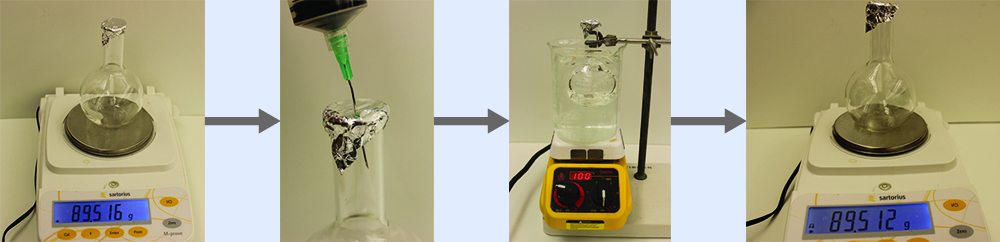
Using this process, a sample of chloroform gas weighing 0.494 yard is collected in a flask with a volume of 129 cm3 at 99.half dozen °C when the atmospheric pressure is 742.i mm Hg. What is the gauge molar mass of chloroform?
Solution
Since [latex]\mathcal{M} = \frac{m}{n}[/latex] and [latex]northward = \frac{PV}{RT}[/latex], substituting and rearranging gives [latex]\mathcal{One thousand} = \frac{mRT}{PV}[/latex],
then
[latex]\mathcal{M} = \frac{mRT}{PV} = \frac{(0.494 \;\text{m}) \times 0.08206 \;\text{L} \cdot \text{atm/mol K} \times 372.viii \;\text{K}}{0.976 \;\text{atm} \times \; 0.129 \;\text{L}} = 120 \;\text{g/mol}[/latex]
Check Your Learning
A sample of phosphorus that weighs 3.243 × ten−2 one thousand exerts a force per unit area of 31.89 kPa in a 56.0-mL bulb at 550 °C. What are the molar mass and molecular formula of phosphorus vapor?
The Pressure level of a Mixture of Gases: Dalton'due south Law
Unless they chemically react with each other, the individual gases in a mixture of gases practise not affect each other'southward pressure. Each individual gas in a mixture exerts the same pressure that information technology would exert if it were nowadays alone in the container (Figure ii). The pressure exerted by each individual gas in a mixture is called its partial pressure. This observation is summarized past Dalton'south constabulary of partial pressures: The total pressure of a mixture of platonic gases is equal to the sum of the fractional pressures of the component gases:
[latex]P_{Total} = P_A + P_B + P_C + \cdots = \sum_{\text{i}} P_\text{i}[/latex]
In the equation PTotal is the total pressure level of a mixture of gases, PA is the partial pressure of gas A; PB is the partial pressure of gas B; PC is the partial pressure of gas C; and so on.
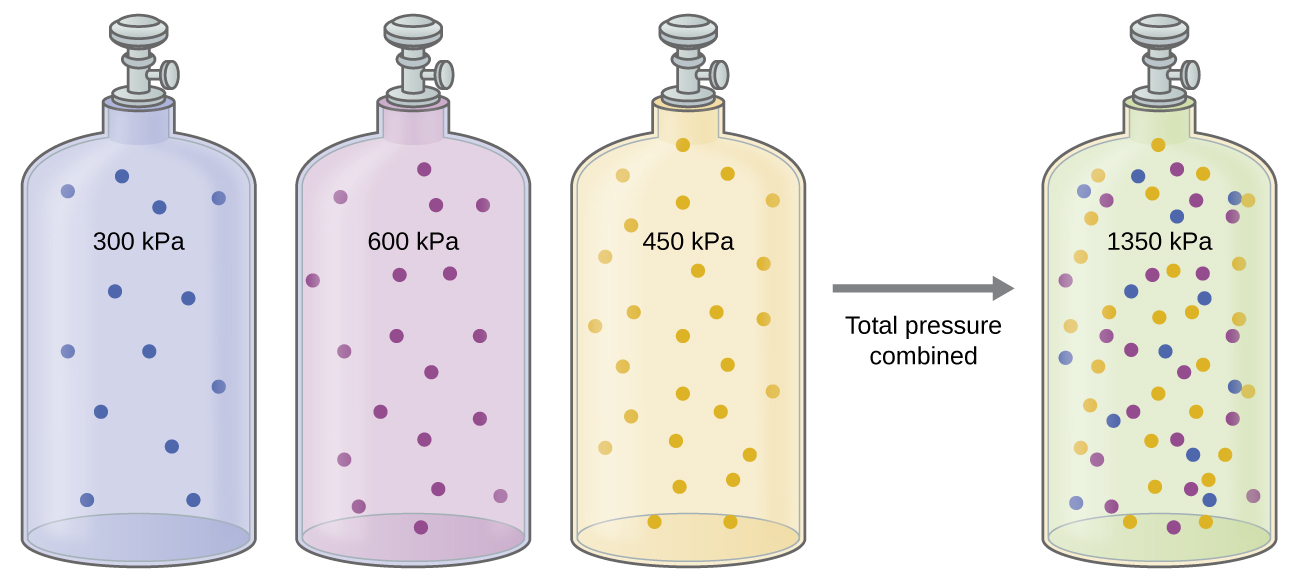
The partial force per unit area of gas A is related to the total pressure level of the gas mixture via its mole fraction (Ten), a unit of measurement of concentration defined every bit the number of moles of a component of a solution divided by the total number of moles of all components:
[latex]P_A = X_A \times P_{Total} \;\;\;\;\; \text{where} \;\;\;\;\; X_A = \frac{n_A}{n_{Total}}[/latex]
where PA , XA , and nA are the fractional pressure, mole fraction, and number of moles of gas A, respectively, and nFull is the number of moles of all components in the mixture.
Example iv
The Pressure of a Mixture of Gases
A 10.0-L vessel contains ii.l × x−3 mol of H2, 1.00 × ten−3 mol of He, and 3.00 × 10−four mol of Ne at 35 °C.
(a) What are the partial pressures of each of the gases?
(b) What is the full force per unit area in atmospheres?
Solution
The gases behave independently, so the fractional pressure level of each gas tin be determined from the platonic gas equation, using [latex]P = \frac{nRT}{V}[/latex]:
[latex]P_{\text{H}_2} = \frac{(2.50 \times ten^{-3} \;\rule[0.5ex]{1.2em}{0.1ex}\hspace{-i.2em}\text{mol})(0.08206 \;\rule[0.5ex]{0.5em}{0.1ex}\hspace{-0.5em}\text{L} \;\text{atm} \;\rule[0.5ex]{iii.5em}{0.1ex}\hspace{-three.5em}\text{mol}^{-1} \text{Yard}^{-1})(308 \;\rule[0.5ex]{0.5em}{0.1ex}\hspace{-0.5em}\text{Thousand})}{10.0 \;\rule[0.5ex]{0.5em}{0.1ex}\hspace{-0.5em}\text{L}} = vi.32 \times ten^{-3} \;\text{atm}[/latex]
[latex]P_\text{He} = \frac{(one.00 \times x^{-3} \;\rule[0.5ex]{i.2em}{0.1ex}\hspace{-1.2em}\text{mol})(0.08206 \;\rule[0.5ex]{0.5em}{0.1ex}\hspace{-0.5em}\text{L} \;\text{atm} \;\rule[0.5ex]{three.5em}{0.1ex}\hspace{-three.5em}\text{mol}^{-1} \text{K}^{-one})(308 \;\dominion[0.5ex]{0.5em}{0.1ex}\hspace{-0.5em}\text{K})}{10.0 \;\dominion[0.5ex]{0.5em}{0.1ex}\hspace{-0.5em}\text{L}} = 2.53 \times x^{-three} \;\text{atm}[/latex]
[latex]P_\text{Ne} = \frac{(3.00 \times x^{-4} \;\dominion[0.5ex]{1.2em}{0.1ex}\hspace{-i.2em}\text{mol})(0.08206 \;\rule[0.5ex]{0.5em}{0.1ex}\hspace{-0.5em}\text{L} \;\text{atm} \;\rule[0.5ex]{3.5em}{0.1ex}\hspace{-3.5em}\text{mol}^{-1} \text{K}^{-1})(308 \;\rule[0.5ex]{0.5em}{0.1ex}\hspace{-0.5em}\text{K})}{10.0 \;\dominion[0.5ex]{0.5em}{0.1ex}\hspace{-0.5em}\text{L}} = vii.58 \times 10^{-4} \;\text{atm}[/latex]
The full pressure is given by the sum of the fractional pressures:
[latex]P_\text{T} = P_{\text{H}_2} + P_\text{He} + P_\text{Ne} = (0.00632 + 0.00253 + 0.00076) \;\text{atm} = 9.61 \times ten^{-3} \;\text{atm}[/latex]
Check Your Learning
A 5.73-L flask at 25 °C contains 0.0388 mol of Northtwo, 0.147 mol of CO, and 0.0803 mol of H2. What is the total pressure in the flask in atmospheres?
Here is another example of this concept, but dealing with mole fraction calculations.
Example 5
The Pressure of a Mixture of Gases
A gas mixture used for anesthesia contains two.83 mol oxygen, O2, and 8.41 mol nitrous oxide, NiiO. The total pressure of the mixture is 192 kPa.
(a) What are the mole fractions of Oii and N2O?
(b) What are the fractional pressures of O2 and North2O?
Solution
The mole fraction is given by [latex]X_A = \frac{n_A}{n_{Full}}[/latex] and the partial force per unit area is [latex]P_A = X_A \times P_{Full}[/latex].
For O2,
[latex]X_{O_2} = \frac{n_{O_2}}{n_{Total}} = \frac{two.83 \;\text{mol}}{(2.83 + 8.41) \;\text{mol}} = 0.252[/latex]
and [latex]P_{O_2} = X_{O_2} \times P_{Total} = 0.252 \times 192 \;\text{kPa} = 48.four \;\text{kPa}[/latex]
For N2O,
[latex]X_{N_2} = \frac{n_{N_2}}{n_{Total}} = \frac{eight.41 \;\text{mol}}{(ii.83 + eight.41) \;\text{mol}} = 0.748[/latex]
and
[latex]P_{N_2} = X_{N_2} \times P_{Total} = 0.748 \times 192 \;\text{kPa} = 143.half-dozen \;\text{kPa}[/latex]
Bank check Your Learning
What is the force per unit area of a mixture of 0.200 g of Htwo, ane.00 thou of Due north2, and 0.820 grand of Ar in a container with a volume of 2.00 50 at xx °C?
Collection of Gases over Water
A simple way to collect gases that practise non react with h2o is to capture them in a bottle that has been filled with water and inverted into a dish filled with water. The force per unit area of the gas inside the bottle tin can be made equal to the air pressure level outside by raising or lowering the canteen. When the water level is the same both inside and outside the bottle (Effigy 3), the pressure of the gas is equal to the atmospheric pressure, which can be measured with a barometer.
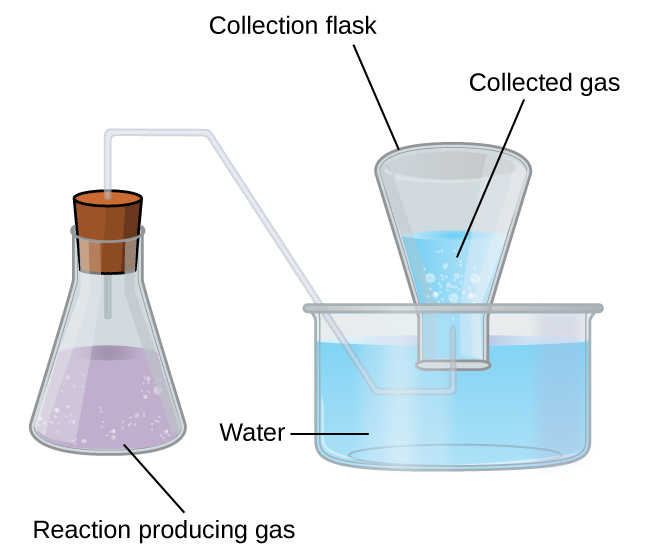
Even so, at that place is another factor nosotros must consider when we measure the pressure of the gas by this method. H2o evaporates and there is always gaseous water (water vapor) above a sample of liquid water. Equally a gas is nerveless over water, it becomes saturated with h2o vapor and the total pressure of the mixture equals the partial pressure of the gas plus the partial pressure of the h2o vapor. The pressure of the pure gas is therefore equal to the full pressure minus the force per unit area of the water vapor—this is referred to as the "dry" gas pressure, that is, the force per unit area of the gas just, without water vapor. The vapor pressure of water, which is the pressure level exerted by water vapor in equilibrium with liquid water in a closed container, depends on the temperature (Figure iv); more than detailed information on the temperature dependence of h2o vapor can be found in Tabular array 2, and vapor pressure will be discussed in more detail in the next affiliate on liquids.
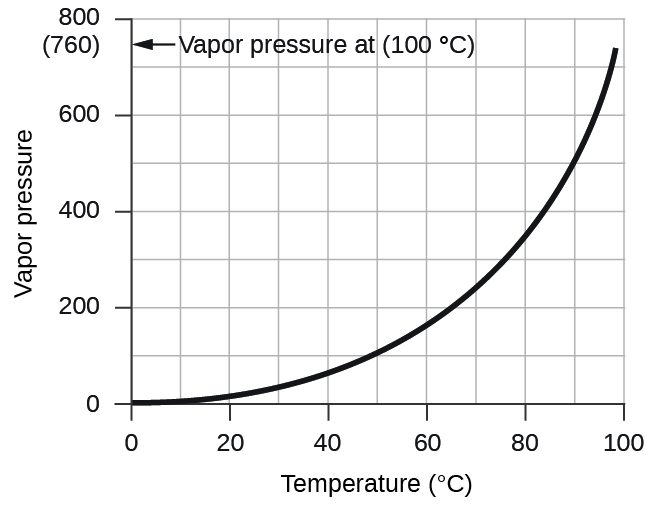
| Temperature (°C) | Pressure (torr) | Temperature (°C) | Pressure level (torr) | Temperature (°C) | Pressure (torr) | ||
|---|---|---|---|---|---|---|---|
| –10 | 1.95 | 18 | 15.five | 30 | 31.8 | ||
| –five | 3.0 | xix | 16.5 | 35 | 42.ii | ||
| –2 | 3.9 | xx | 17.5 | 40 | 55.3 | ||
| 0 | 4.vi | 21 | 18.7 | 50 | 92.v | ||
| ii | 5.3 | 22 | 19.8 | 60 | 149.4 | ||
| iv | 6.1 | 23 | 21.1 | 70 | 233.seven | ||
| half-dozen | vii.0 | 24 | 22.four | lxxx | 355.ane | ||
| viii | eight.0 | 25 | 23.8 | 90 | 525.eight | ||
| x | 9.two | 26 | 25.2 | 95 | 633.9 | ||
| 12 | x.five | 27 | 26.7 | 99 | 733.2 | ||
| 14 | 12.0 | 28 | 28.3 | 100.0 | 760.0 | ||
| sixteen | 13.half-dozen | 29 | 30.0 | 101.0 | 787.6 | ||
| Table 2. Vapor Pressure level of Ice and H2o in Diverse Temperatures at Sea Level | |||||||
Example 6
Pressure of a Gas Nerveless Over Water
If 0.200 L of argon is collected over water at a temperature of 26 °C and a pressure of 750 torr in a system like that shown in Figure 3, what is the partial force per unit area of argon?
Solution
According to Dalton's law, the total pressure in the bottle (750 torr) is the sum of the fractional force per unit area of argon and the partial pressure level of gaseous water:
[latex]P_\text{T} = P_\text{Ar} + P_{{\text{H}_2}\text{O}}[/latex]
Rearranging this equation to solve for the pressure of argon gives:
[latex]P_\text{Ar} = P_\text{T} - P_{{\text{H}_2}\text{O}}[/latex]
The force per unit area of water vapor to a higher place a sample of liquid water at 26 °C is 25.two torr (Appendix East), so:
[latex]P_\text{Ar} = 750 \;\text{torr} - 25.2 \;\text{torr} = 725 \;\text{torr}[/latex]
Check Your Learning
A sample of oxygen nerveless over h2o at a temperature of 29.0 °C and a pressure of 764 torr has a book of 0.560 L. What volume would the dry oxygen have under the same conditions of temperature and pressure?
Chemical Stoichiometry and Gases
Chemic stoichiometry describes the quantitative relationships between reactants and products in chemical reactions.
We have previously measured quantities of reactants and products using masses for solids and volumes in conjunction with the molarity for solutions; now we tin too use gas volumes to indicate quantities. If nosotros know the volume, force per unit area, and temperature of a gas, we can use the ideal gas equation to summate how many moles of the gas are present. If we know how many moles of a gas are involved, we can calculate the volume of a gas at whatever temperature and pressure.
Avogadro'due south Law Revisited
Sometimes we can take advantage of a simplifying characteristic of the stoichiometry of gases that solids and solutions do not exhibit: All gases that show ideal behavior contain the same number of molecules in the same volume (at the aforementioned temperature and force per unit area). Thus, the ratios of volumes of gases involved in a chemical reaction are given by the coefficients in the equation for the reaction, provided that the gas volumes are measured at the aforementioned temperature and force per unit area.
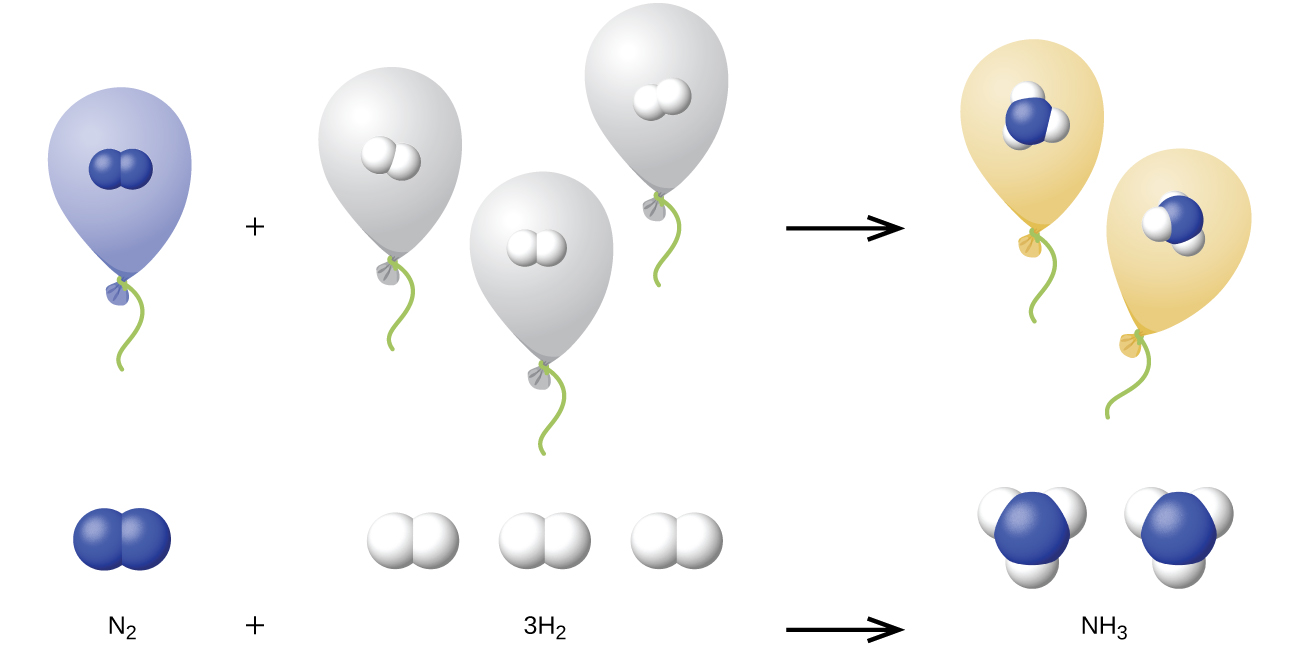
Nosotros can extend Avogadro'due south law (that the volume of a gas is directly proportional to the number of moles of the gas) to chemical reactions with gases: Gases combine, or react, in definite and simple proportions by volume, provided that all gas volumes are measured at the same temperature and pressure level. For example, since nitrogen and hydrogen gases react to produce ammonia gas according to [latex]\text{N}_2(g) + 3\text{H}_2(1000) \longrightarrow 2\text{NH}_3(g)[/latex], a given book of nitrogen gas reacts with 3 times that volume of hydrogen gas to produce two times that volume of ammonia gas, if pressure level and temperature remain constant.
The caption for this is illustrated in Figure 5. According to Avogadro's police, equal volumes of gaseous Ntwo, H2, and NH3, at the same temperature and pressure, contain the same number of molecules. Because i molecule of Northward2 reacts with three molecules of Htwo to produce two molecules of NHiii, the volume of H2 required is three times the volume of N2, and the volume of NH3 produced is two times the book of N2.
Example 7
Reaction of Gases
Propane, C3H8(chiliad), is used in gas grills to provide the heat for cooking. What volume of O2(k) measured at 25 °C and 760 torr is required to react with 2.7 L of propane measured nether the same conditions of temperature and pressure? Assume that the propane undergoes complete combustion.
Solution
The ratio of the volumes of C3H8 and O2 will exist equal to the ratio of their coefficients in the balanced equation for the reaction:
[latex]\begin{array}{fifty c r} \text{C}_3 \text{H}_8(g) + 5\text{O}_2(g) & \longrightarrow & iii\text{CO}_2(g) + 4\text{H}_2 \text{O}(50) \\[1em] 1 \;\text{volume} + 5 \;\text{volumes} & & 3 \;\text{volumes} + four \;\text{volumes} \end{assortment}[/latex]
From the equation, we see that 1 volume of C3H8 will react with five volumes of O2:
[latex]two.7 \;\dominion[0.75ex]{3.2em}{0.1ex}\hspace{-3.2em}\text{L C}_3 \text{H}_8 \times \frac{5 \;\text{L O}_2}{one \;\dominion[0.35ex]{ii.5em}{0.1ex}\hspace{-2.5em}\text{L C}_3 \text{H}_8} = 13.five \;\text{Fifty O}_2[/latex]
A book of xiii.5 50 of O2 will exist required to react with 2.7 L of C3Hviii.
Bank check Your Learning
An acetylene tank for an oxyacetylene welding torch provides 9340 L of acetylene gas, C2Hii, at 0 °C and i atm. How many tanks of oxygen, each providing vii.00 × 103 L of O2 at 0 °C and 1 atm, will be required to burn the acetylene?
[latex]2\text{C}_2 \text{H}_2 + 5\text{O}_2 \longrightarrow four\text{CO}_2 + 2\text{H}_2 \text{O}[/latex]
Answer:
iii.34 tanks (2.34 × 10⁴ Fifty)
Example 8
Volumes of Reacting Gases
Ammonia is an important fertilizer and industrial chemical. Suppose that a book of 683 billion cubic anxiety of gaseous ammonia, measured at 25 °C and one atm, was manufactured. What volume of H2(g), measured under the aforementioned weather, was required to set this corporeality of ammonia by reaction with N2?
[latex]\text{N}_2(g) + three\text{H}_2(yard) \longrightarrow ii\text{NH}_3(g)[/latex]
Solution
Because equal volumes of Hii and NHiii contain equal numbers of molecules and each three molecules of H2 that react produce two molecules of NH3, the ratio of the volumes of H2 and NH3 will be equal to 3:ii. Two volumes of NH3, in this case in units of billion ft3, will be formed from 3 volumes of H2:
[latex]683 \;\rule[0.75ex]{6.5em}{0.1ex}\hspace{-six.5em}\text{billion ft}^3 \;\text{NH}_3 \times \frac{3 \;\text{billion ft}^3 \;\text{H}_2}{two \;\rule[0.5ex]{iv.7em}{0.1ex}\hspace{-4.7em}\text{billion ft}^3 \;\text{NH}_3} = i.02 \times ten^3 \;\text{billion ft}^3 \;\text{H}_2[/latex]
The manufacture of 683 billion ftthree of NH3 required 1020 billion ft3 of Htwo. (At 25 °C and ane atm, this is the volume of a cube with an edge length of approximately 1.ix miles.)
Cheque Your Learning
What volume of O2(g) measured at 25 °C and 760 torr is required to react with 17.0 L of ethylene, CiiH4(g), measured under the same conditions of temperature and pressure level? The products are COii and h2o vapor.
Case 9
Volume of Gaseous Production
What volume of hydrogen at 27 °C and 723 torr may be prepared by the reaction of 8.88 g of gallium with an excess of hydrochloric acid?
[latex]2\text{Ga}(south) + 6 \text{HCl}(aq) \longrightarrow ii\text{GaCl}_3 (aq) + 3\text{H}_2(1000)[/latex]
Solution
To catechumen from the mass of gallium to the volume of H2(1000), we need to do something like this:

The kickoff two conversions are:
[latex]8.88 \;\rule[0.75ex]{2.5em}{0.1ex}\hspace{-two.5em}\text{1000 Ga} \times \frac{1 \;\rule[0.5ex]{2.5em}{0.1ex}\hspace{-2.5em}\text{mol Ga}}{69.723 \;\rule[0.5ex]{1.5em}{0.1ex}\hspace{-1.5em}\text{g Ga}} \times \frac{3 \;\text{mol H}_2}{2 \;\rule[0.5ex]{2.5em}{0.1ex}\hspace{-2.5em}\text{mol Ga}} = 0.191 \;\text{mol H}_2[/latex]
Finally, we can employ the ideal gas police force:
[latex]V_{\text{H}_2} = (\frac{nRT}{P})_{\text{H}_2} = \frac{0.191 \;\rule[0.5ex]{1.25em}{0.1ex}\hspace{-1.25em}\text{mol} \times 0.08206 \;\text{50} \;\rule[0.5ex]{iv.5em}{0.1ex}\hspace{-4.5em}\text{atm mol}^{-1} \text{Yard}^{-i} \times 300 \;\text{Thousand}}{0.951 \;\rule[0.5ex]{one.4em}{0.1ex}\hspace{-1.4em}\text{atm}} = 4.94 \;\text{L}[/latex]
Check Your Learning
Sulfur dioxide is an intermediate in the preparation of sulfuric acid. What volume of SO2 at 343 °C and ane.21 atm is produced past burning l.00 kg of sulfur in oxygen?
Greenhouse Gases and Climate Change
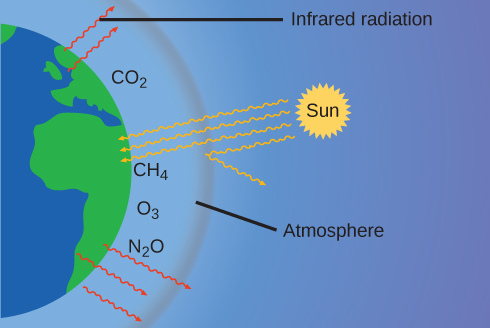
The thin skin of our temper keeps the earth from beingness an ice planet and makes information technology habitable. In fact, this is due to less than 0.5% of the air molecules. Of the free energy from the sun that reaches the earth, most [latex]\frac{1}{three}[/latex] is reflected back into space, with the balance captivated by the atmosphere and the surface of the earth. Some of the energy that the earth absorbs is re-emitted as infrared (IR) radiation, a portion of which passes back out through the atmosphere into space. However, about of this IR radiations is captivated past certain substances in the temper, known as greenhouse gases, which re-emit this free energy in all directions, trapping some of the estrus. This maintains favorable living conditions—without atmosphere, the boilerplate global average temperature of xiv °C (57 °F) would exist about –nineteen °C (–2 °F). The major greenhouse gases (GHGs) are water vapor, carbon dioxide, methane, and ozone. Since the Industrial Revolution, human being activity has been increasing the concentrations of GHGs, which have changed the energy balance and are significantly altering the world's climate (Figure 6).
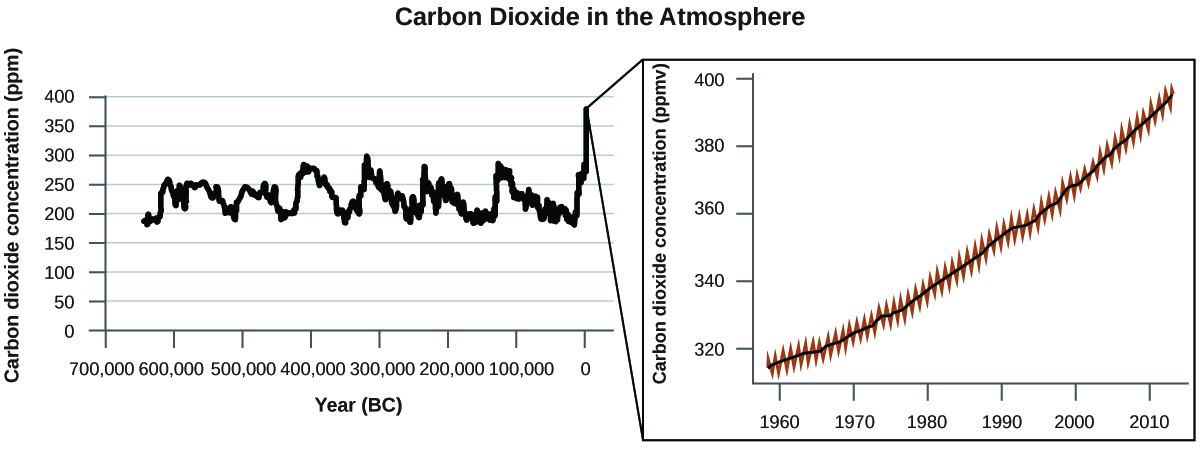
At that place is potent evidence from multiple sources that college atmospheric levels of COtwo are acquired past human action, with fossil fuel burning accounting for about [latex]\frac{iii}{four}[/latex] of the recent increment in CO2. Reliable data from water ice cores reveals that COii concentration in the atmosphere is at the highest level in the past 800,000 years; other show indicates that it may be at its highest level in 20 million years. In recent years, the CO2 concentration has increased from historical levels of below 300 ppm to almost 400 ppm today (Figure vii).

Click here to run across a two-minute video explaining greenhouse gases and global warming.
Susan Solomon
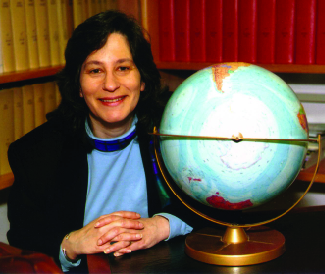
Atmospheric and climate scientist Susan Solomon (Figure eight) is the writer of i of The New York Times books of the year (The Coldest March, 2001), one of Time magazine's 100 nigh influential people in the world (2008), and a working grouping leader of the Intergovernmental Panel on Climate change (IPCC), which was the recipient of the 2007 Nobel Peace Prize. She helped determine and explain the cause of the formation of the ozone hole over Antarctica, and has authored many important papers on climatic change. She has been awarded the top scientific honors in the U.s. and French republic (the National Medal of Science and the Grande Medaille, respectively), and is a member of the National University of Sciences, the Royal Society, the French Academy of Sciences, and the European Academy of Sciences. Formerly a professor at the Academy of Colorado, she is now at MIT, and continues to work at NOAA.
For more than data, watch this video about Susan Solomon.
Key Concepts and Summary
The platonic gas police force tin can be used to derive a number of user-friendly equations relating directly measured quantities to backdrop of interest for gaseous substances and mixtures. Appropriate rearrangement of the ideal gas equation may be made to permit the calculation of gas densities and molar masses. Dalton'south constabulary of partial pressures may be used to chronicle measured gas pressures for gaseous mixtures to their compositions. Avogadro'southward police may be used in stoichiometric computations for chemical reactions involving gaseous reactants or products.
Key Equations
- [latex]P_{Full} = P_A + P_B + P_C + \cdots = \sum_\text{i} P_\text{i}[/latex]
- [latex]P_A = X_A P_{Full}[/latex]
- [latex]X_A = \frac{n_A}{n_{Total}}[/latex]
Chemical science Terminate of Chapter Exercises
- What is the density of laughing gas, dinitrogen monoxide, N2O, at a temperature of 325 K and a force per unit area of 113.0 kPa?
- Calculate the density of Freon 12, CF2Cl2, at 30.0 °C and 0.954 atm.
- Which is denser at the same temperature and force per unit area, dry air or air saturated with water vapor? Explain.
- A cylinder of O2(g) used in breathing by emphysema patients has a volume of 3.00 L at a pressure level of 10.0 atm. If the temperature of the cylinder is 28.0 °C, what mass of oxygen is in the cylinder?
- What is the molar mass of a gas if 0.0494 g of the gas occupies a volume of 0.100 L at a temperature 26 °C and a pressure of 307 torr?
- What is the molar mass of a gas if 0.281 g of the gas occupies a volume of 125 mL at a temperature 126 °C and a pressure of 777 torr?
- How could you show experimentally that the molecular formula of propene is C3H6, non CH2?
- The density of a certain gaseous fluoride of phosphorus is 3.93 g/L at STP. Calculate the molar mass of this fluoride and decide its molecular formula.
- Consider this question: What is the molecular formula of a compound that contains 39% C, 45% Northward, and sixteen% H if 0.157 g of the compound occupies l25 mL with a force per unit area of 99.five kPa at 22 °C?
(a) Outline the steps necessary to answer the question.
(b) Reply the question.
- A 36.0–50 cylinder of a gas used for scale of blood gas analyzers in medical laboratories contains 350 g COii, 805 chiliad O2, and iv,880 m Northtwo. At 25 degrees C, what is the pressure in the cylinder in atmospheres?
- A cylinder of a gas mixture used for scale of blood gas analyzers in medical laboratories contains 5.0% CO2, 12.0% Oii, and the remainder N2 at a total pressure of 146 atm. What is the partial pressure of each component of this gas? (The percentages given signal the percent of the total force per unit area that is due to each component.)
- A sample of gas isolated from unrefined petroleum contains xc.0% CHiv, 8.9% C2H6, and 1.ane% CthreeHviii at a full pressure of 307.two kPa. What is the fractional pressure level of each component of this gas? (The percentages given indicate the percent of the total pressure that is due to each component.)
- A mixture of 0.200 thousand of Htwo, one.00 grand of Northwardii, and 0.820 g of Ar is stored in a closed container at STP. Find the volume of the container, assuming that the gases exhibit ideal behavior.
- About mixtures of hydrogen gas with oxygen gas are explosive. However, a mixture that contains less than 3.0 % O2 is not. If enough Oii is added to a cylinder of Hii at 33.2 atm to bring the total force per unit area to 34.v atm, is the mixture explosive?
- A commercial mercury vapor analyzer can detect, in air, concentrations of gaseous Hg atoms (which are poisonous) as low every bit two × 10−6 mg/L of air. At this concentration, what is the partial pressure level of gaseous mercury if the atmospheric pressure is 733 torr at 26 °C?
- A sample of carbon monoxide was collected over water at a total force per unit area of 756 torr and a temperature of 18 °C. What is the pressure level of the carbon monoxide? (Run across Table 2 for the vapor pressure of water.)
- In an experiment in a general chemistry laboratory, a student collected a sample of a gas over water. The book of the gas was 265 mL at a pressure of 753 torr and a temperature of 27 °C. The mass of the gas was 0.472 g. What was the tooth mass of the gas?
- Joseph Priestley first prepared pure oxygen by heating mercuric oxide, HgO:
[latex]two \text{HgO}(due south) \longrightarrow 2\text{Hg}(l) + \text{O}_2(g)[/latex](a) Outline the steps necessary to answer the post-obit question: What book of Oii at 23 °C and 0.975 atm is produced by the decomposition of 5.36 g of HgO?
(b) Answer the question.
- Cavendish prepared hydrogen in 1766 past the novel method of passing steam through a red-hot gun barrel:
[latex]4 \text{H}_2 \text{O}(thou) + iii\text{Fe}(south) \longrightarrow \text{Fe}_3 \text{O}_4 + iv\text{H}_2(1000)[/latex](a) Outline the steps necessary to answer the following question: What book of H2 at a pressure of 745 torr and a temperature of 20 °C can be prepared from the reaction of 15.O g of HtwoO?
(b) Answer the question.
- The chlorofluorocarbon CCltwoF2 tin be recycled into a unlike compound past reaction with hydrogen to produce CH2Ftwo(g), a compound useful in chemical manufacturing:
[latex]\text{CCl}_2 \text{F}_2(g) + 4 \text{H}_2(g) \longrightarrow \text{CH}_2 \text{F}_2(g) + 2\text{HCl}(g)[/latex]
(a) Outline the steps necessary to reply the following question: What book of hydrogen at 225 atm and 35.5 °C would exist required to react with 1 ton (1.000 × x3 kg) of CCltwoF2?(b) Respond the question.
- Auto air bags are inflated with nitrogen gas, which is formed past the decomposition of solid sodium azide (NaNiii). The other product is sodium metal. Calculate the book of nitrogen gas at 27 °C and 756 torr formed by the decomposition of 125 one thousand of sodium azide.
- Lime, CaO, is produced by heating calcium carbonate, CaCO3; carbon dioxide is the other product.
(a) Outline the steps necessary to answer the following question: What volume of carbon dioxide at 875° and 0.966 atm is produced by the decomposition of i ton (i.000 × 103 kg) of calcium carbonate?
(b) Answer the question.
- Earlier pocket-sized batteries were available, carbide lamps were used for bicycle lights. Acetylene gas, C2H2, and solid calcium hydroxide were formed by the reaction of calcium carbide, CaC2, with water. The ignition of the acetylene gas provided the light. Currently, the same lamps are used by some cavers, and calcium carbide is used to produce acetylene for carbide cannons.
(a) Outline the steps necessary to respond the following question: What volume of CiiH2 at ane.005 atm and 12.2 °C is formed by the reaction of 15.48 g of CaC2 with h2o?
(b) Answer the question.
- Summate the volume of oxygen required to burn 12.00 L of ethane gas, CiiHhalf-dozen, to produce carbon dioxide and h2o, if the volumes of CtwoH6 and O2 are measured under the same conditions of temperature and pressure level.
- What book of Oii at STP is required to oxidize 8.0 L of NO at STP to NO2? What book of NOii is produced at STP?
- Consider the following questions:
(a) What is the total volume of the CO2(g) and H2O(m) at 600 °C and 0.888 atm produced by the combustion of one.00 L of C2H6(g) measured at STP?
(b) What is the partial pressure level of HtwoO in the product gases?
- Methanol, CH3OH, is produced industrially by the following reaction:[latex]\text{CO}(m) + 2 \text{H}_2(g) \xrightarrow{\;\;\;\;\;\;\text{copper goad} \;300 \;^{\circ} \text{C},\;300 \;\text{atm}\;\;\;\;\;\;} \text{CH}_3 \text{OH}(yard)[/latex]
Assuming that the gases comport as ideal gases, discover the ratio of the total book of the reactants to the final book. - What book of oxygen at 423.0 K and a force per unit area of 127.four kPa is produced by the decomposition of 129.seven yard of BaO2 to BaO and O2?
- A 2.fifty-50 sample of a colorless gas at STP decomposed to give 2.50 Fifty of Nii and 1.25 50 of O2 at STP. What is the colorless gas?
- Ethanol, CtwoH5OH, is produced industrially from ethylene, CtwoH4, past the following sequence of reactions:
[latex]iii \text{C}_2 \text{H}_4 + ii\text{H}_2 \text{SO}_4 \longrightarrow \text{C}_2 \text{H}_5 \text{HSO}_4 + (\text{C}_2 \text{H}_5)_2 \text{SO}_4[/latex]
[latex]\text{C}_2 \text{H}_5 \text{HSO}_4 + (\text{C}_2 \text{H}_5)_2 \text{SO}_4 + 3\text{H}_2 \text{O} \longrightarrow three\text{C}_2 \text{H}_5 \text{OH} + ii\text{H}_2 \text{And then}_4[/latex]
What volume of ethylene at STP is required to produce 1.000 metric ton (1000 kg) of ethanol if the overall yield of ethanol is ninety.1%? - Ane molecule of hemoglobin volition combine with four molecules of oxygen. If ane.0 g of hemoglobin combines with 1.53 mL of oxygen at trunk temperature (37 °C) and a pressure level of 743 torr, what is the molar mass of hemoglobin?
- A sample of a compound of xenon and fluorine was bars in a bulb with a force per unit area of 18 torr. Hydrogen was added to the bulb until the pressure level was 72 torr. Passage of an electric spark through the mixture produced Xe and HF. Subsequently the HF was removed by reaction with solid KOH, the final pressure of xenon and unreacted hydrogen in the bulb was 36 torr. What is the empirical formula of the xenon fluoride in the original sample? (Note: Xenon fluorides incorporate only one xenon atom per molecule.)
- 1 method of analyzing amino acids is the van Slyke method. The characteristic amino groups (−NH2) in poly peptide material are allowed to react with nitrous acid, HNO2, to form Due north2 gas. From the volume of the gas, the amount of amino acrid tin can be determined. A 0.0604-g sample of a biological sample containing glycine, CH2(NHii)COOH, was analyzed by the van Slyke method and yielded 3.lxx mL of North2 nerveless over water at a pressure of 735 torr and 29 °C. What was the percentage of glycine in the sample?
[latex]\text{CH}_2 \; (\text{NH}_2) \text{CO}_2 \text{H} + \text{HNO}_2 \longrightarrow \text{CH}_2 \;(\text{OH}) \text{CO}_2 \text{H} + \text{H}_2 \text{O} + \text{N}_2[/latex]
Glossary
- Dalton's law of partial pressures
- total pressure level of a mixture of ideal gases is equal to the sum of the partial pressures of the component gases.
- mole fraction (X)
- concentration unit of measurement defined as the ratio of the tooth corporeality of a mixture component to the total number of moles of all mixture components
- fractional pressure
- pressure exerted by an individual gas in a mixture
- vapor pressure of water
- pressure exerted by water vapor in equilibrium with liquid water in a airtight container at a specific temperature
Solutions
Answers to Chemistry End of Affiliate Exercises
ii. four.64 g L−1
4. 38.viii thousand
6. 72.0 m mol−1
eight. 88.1 grand mol−1; PF3
10. 141 atm
12. CH4: 276 kPa; C2H6: 27 kPa; CthreeHviii: iii.4 kPa
xiv. Aye
16. 740 torr
18. (a) Determine the moles of HgO that decompose; using the chemical equation, determine the moles of O2 produced past decomposition of this amount of HgO; and determine the book of Otwo from the moles of Oii, temperature, and force per unit area. (b) 0.308 L
20. (a) Determine the molar mass of CCliiFii. From the balanced equation, calculate the moles of Htwo needed for the complete reaction. From the platonic gas constabulary, convert moles of H2 into volume. (b) 3.72 × x3 L
22. (a) Rest the equation. Determine the grams of CO2 produced and the number of moles. From the ideal gas police force, determine the book of gas. (b) 7.43 × 10⁵ L
24. 42.00 Fifty
26. (a) 18.0 L; (b) 0.533 atm
28. 10.57 Fifty O2
xxx. five.forty × ten5 L
32. XeF2
Source: https://opentextbc.ca/chemistry/chapter/9-3-stoichiometry-of-gaseous-substances-mixtures-and-reactions/
0 Response to "225 G Nan3 React to Fill Airbag How Much Pv Work Will N2 Do Agains"
Post a Comment